
Archives
-
Inaugural Issue of the Journal of Belizean Research
Vol. 1 No. 1 (2022)This is the Inaugural Issue of the Journal of Belizean Research.
JOBR publishes papers from across all academic fields with journal sections dedicated to:
- Health, Natural Sciences, and Technology
- Management and Social Science
- Education and Humanities
-
Journal of Belizean Research
Vol. 1 No. 2 (2023)This issue reflects the breadth of scholarly inquiry shaping national discourse. From marine biodiversity and sustainable agriculture to urban social realities, public health perceptions, and democratic governance, the contributions demonstrate the role of interdisciplinary research in advancing evidence-based development in Belize.
-
Journal of Belizean Research
Vol. 2 No. 1 (2024)This issue features research in infrastructure and road safety, information technology, environmental science, and education.
The Health, Natural Sciences, and Technology section highlights data-driven road safety innovation, diversity within the University of Belize’s IT program, and experimental studies on herbicide behavior in biochar-amended tropical soils. The Education and Humanities section explores teacher efficacy, school climate, leadership, and psychological well-being within Belizean schools.
Together, these contributions reflect the journal’s commitment to advancing rigorous, locally grounded research that informs policy, practice, and sustainable national progress.
-
Journal of Belizean Research
Vol. 2 No. 2 (2024)This issue of the Journal of Belizean Research explores themes of climate resilience, public health, traditional medicine, and educational development within Belize and the wider Latin American and Caribbean region.
Articles examine local-level climate change risk analysis, regional food environments and public health, and the use of medicinal plants in hypertension management in Belize. The Education and Humanities section investigates factors affecting teachers’ anxiety in mathematics instruction and evaluates the impact of learning strategies and growth mindset interventions on student achievement.
Together, these contributions highlight the role of research in strengthening environmental resilience, community health, and educational outcomes in Belize and the Caribbean.
-
Journal of Belizean Research
Vol. 3 No. 1 (2025)This issue presents interdisciplinary scholarship addressing agricultural innovation, healthcare systems, public services, national identity, and educational leadership in Belize.
The Health, Natural Sciences, and Technology section features research on tomato production in protected agriculture systems and an evaluation of prescription errors and pharmacists’ interventions in a Belizean hospital. The Management and Social Sciences section examines public opinion on national infrastructure and essential services. The Education and Humanities section revisits the historical origins of the Belize settlement and explores the impact of transformational leadership on teachers’ motivation and commitment.
Together, these contributions reflect the journal’s continued focus on evidence-based research that informs agricultural development, public health, governance, education, and national understanding.
-
Journal of Belizean Research
Vol. 3 No. 2 (2025)This issue explores innovation, heritage, institutional systems, and global engagement within Belize and the wider region.
The Health, Natural Sciences, and Technology section includes a historical analysis of Vanilla pompona with emphasis on Central American usage and an examination of awareness and preparedness surrounding artificial intelligence at the University of Belize. The Management and Social Sciences section investigates recidivism at the Belize Central Prison, contributing to discussions on justice and rehabilitation. The Education and Humanities section highlights international collaboration through innovation and exchange between Belizean principals and U.S. teacher candidates.
Together, these articles reflect the dynamic interplay between tradition and technology, local systems and global partnerships, underscoring the journal’s commitment to research that informs cultural understanding, institutional development, and forward-looking innovation.
-
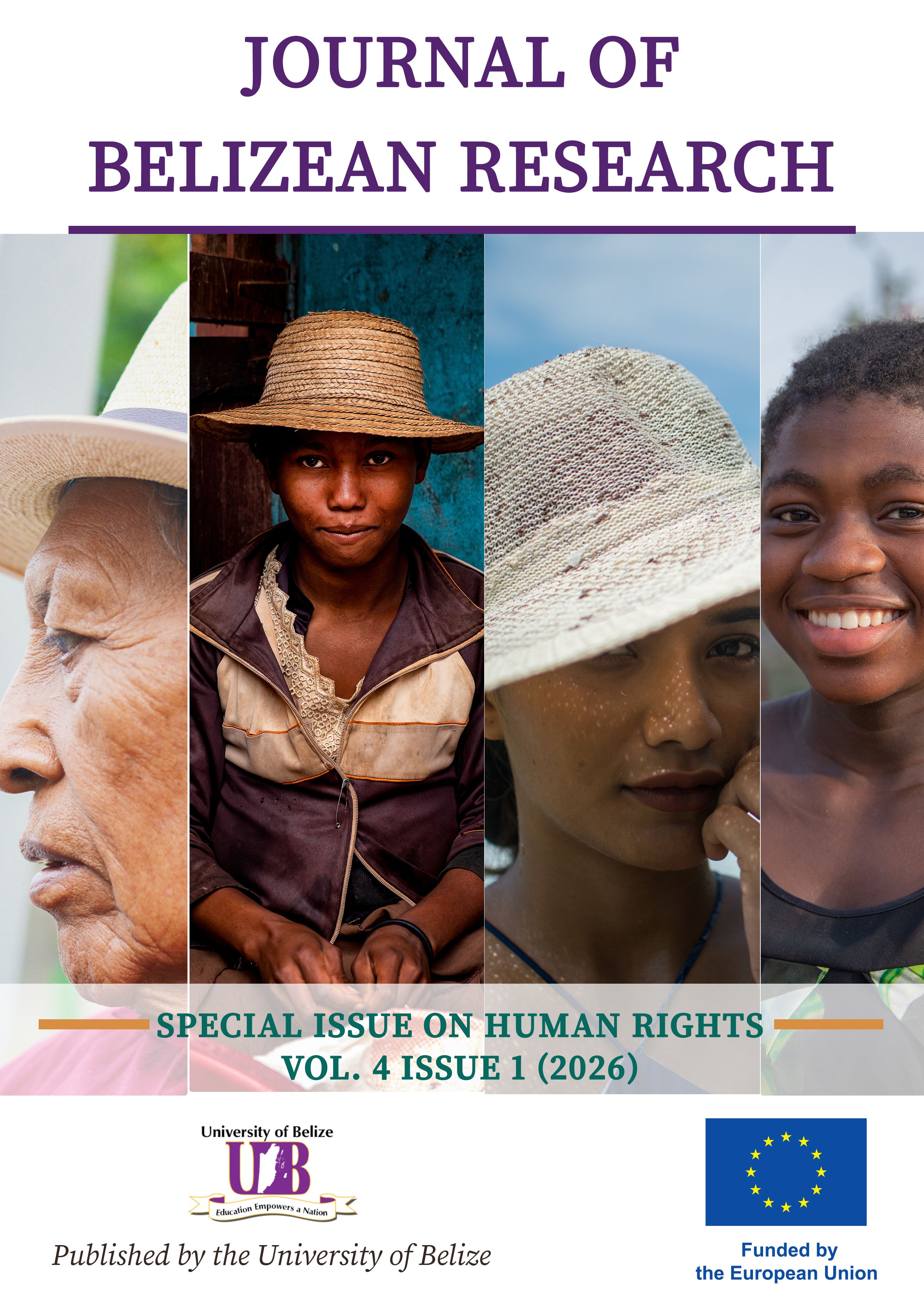
Journal of Belizean Research - Special Issue on Human Rights
Vol. 4 No. 1 (2026)Special Issue Description: Contemporary Human Rights Challenges in Belize
This special issue of the Journal of Belizean Research examines contemporary human rights challenges in Belize through a multidisciplinary, evidence-based lens. Developed as a key output of the European Union–funded project Strengthening Human Rights Advocacy Among Youth in Belize Through Academic Research, Capacity Building, and Human Rights Education, the volume contributes to strengthening the national human rights knowledge base by advancing rigorous academic inquiry. Collectively, the eight articles interrogate how economic, social, cultural, civil, and political rights are experienced, constrained, and contested within Belize’s evolving legal, technological, and socio-political landscape.
The contributions address a wide range of pressing issues, including indigenous and communal land rights, the human rights implications of artificial intelligence, emergency governance during the COVID-19 pandemic, disability and access to health and employment, migrant sex workers’ vulnerability under conditions of criminalization and stigma, intersectional discrimination affecting women and LGBTQ+ families, and adolescent well-being during periods of social and economic disruption. Using diverse methodological and theoretical approaches, the articles foreground patterns of exclusion, marginalization, and structural inequality, while also identifying opportunities for policy reform and rights-based advocacy. Taken together, the special issue not only expands the availability of empirical data on human rights in Belize but also underscores, consistent with recent trend-mapping research, that the field remains open and urgent for sustained future scholarship and intervention.